
Should you use 12v or an Inverter?
Almost every electrical device you can take in your campervan can be powered directly from your 12v battery rather than needing an a/c inverter, or an alternative can be found, like a toast rack for your hob instead of an electric toaster. For example using an inverter to power your TV, Laptop or to charge your phone or tablet is like pushing a car to and from the shops just to pick up some milk. An inverter can be just as much a waste of the energy in your 12v battery.
We use a 2000w inverter, https://amzn.to/37Xkkdj
You can get usb sockets directly powered off your 12v electrics. Most TVs have a power adapter that converts mains power (240 or 110v) to 12 to 19v which means you can power your tv from your 12v electrics with ease and without an inverter. Your laptop charger can be replaced with a 12v version too, they’re inexpensive and work just the same. The TV or laptop 12v to 19v power adapters are on scambay for around £20.
12v Universal chargers adapters for laptops and TVs for example
12v to USB hard wired charging point links
However, for some appliances an inverter is a must and for that reason here’s how to gauge what size to buy and how to install it.
I’m going to use my setup as an example, and the reasons why I’m fitting an inverter are not applicable to all.
First of all you need to make sure you know how much power you’ll need so you buy the correct inverter. For example a 21” TV 240 v would need around 30 watts of power, inverters are usually marked as their max operating watts, so make sure you get at least a 60W inverter for a 30W TV. In my scenario Mandy wants to run a coffee maker that peaks at 1000 watts, you can use a plug power tester to check what your device will use in watts. So our inverter needs to be 2000 watts in order to cope with the power surge of turning on the coffee maker as it starts to boil the water.
There are many different inverter models, sizes and types out there, you will see some that say Pure Sine Wave and others might say Modified Sine wave. As it says, one is pure and the other is engineered, the sine wave is the actual power. DC is direct current and AC is alternating current, so a wave of power is what we need to get AC and this is the sine wave. Modern electronics are very sensitive to the power they are connected to, laptop, smartphone chargers and for example drone battery chargers, they all want to see a very even flow of power.
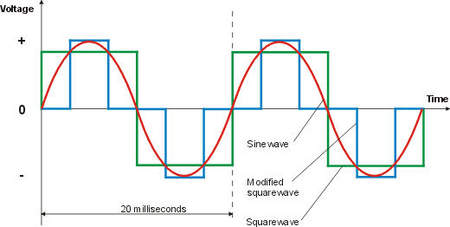
So I’m fitting a pure sine wave, they are far better at converting 12v DC to 240v AC, but that’s only the start of this. We now need to work out what amps this inverter will draw from the 12v leisure batteries. Inverters should only ever be installed to your leisure batteries and NEVER to your vehicle starter battery as you could drain your starter battery and leave your vehicle stranded, the vehicle starter battery will not be designed to run an inverter for very long either.
So in my example the 1000 watt (peak draw) coffee maker will draw big amps, so I need to work out the amps the inverter will draw from my batteries.
Here you do some maths (math for you americans) so we divide our WATS by our VOLTS; 1000 / 12 = 83 Amps per hour will be used, but the coffee maker only takes around 3 minutes to make the drink. So running the inverter for a coffee maker for a few minutes a day will not impact on the batteries that much. However, in order to minimise that impact, and the fact I could be using the inverter for other things during the day, I have 2 batteries, each 130Ah giving me a total of 260 Amps per hour – but then leisure batteries typically can only provide 50% of their power at a given time, which drops me back to 130 Ah – still more than enough to power the inverter to power the coffee maker.
The batteries and how they are wired are also very crucial when using large capacity inverters. Wiring multiple batteries together should be done a specific way, not just connecting all the – and + terminals together, that does work but it’s how you then draw the power from that battery bank that’s crucial. The first diagram below is how most people do this…
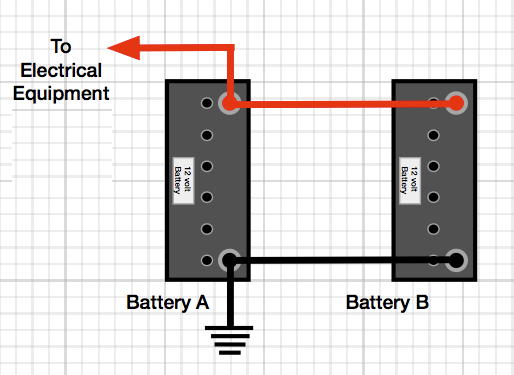
And what they don’t understand is battery A will give out all its power first and battery B will try and recharge battery A. This isn’t what you want to do, it’s close and the real solution is very simple.

This is the correct way to wire your batteries, so the 12v power flows through battery A into battery B and out, so both batteries are now correctly acting as one bigger battery bank.
So this is how my 2 x 130Ah batteries are wired. I then connect the inverter – to battery A – and then inverter + to Battery B + and this will power the inverter perfectly. The inverter I chose has an inline fuse, as the Amps are very big I can’t wire the inverter through the fuse box, so you need to wire your inverter directly to your battery terminals, so you should fit an inline fuse if your inverter doesn’t come with one. My inverter also has a remote power switch so I can switch it on only when I need its power, your inverter will use up a lot of power every day if you leave it switched on even if nothing is plugged into it, so always switch off your inverter when it’s not being used.
130Ah 12v Battery Purchase link https://goo.gl/eRGHkW
My inverter has 2 power AC sockets and USB sockets, I don’t recommend you use your inverters USB sockets to charge smartphones or tablets, as they could spike during the inverters operation to produce AC. I’m going to extend 1 of my AC sockets to the kitchen area and the other I will connect into as and when I want power. I’m going to place the inverters remote power switch near the extended outlet too, so it’s easier to operate.
Due to some comments on this topic I wanted to point out this isn’t a product review, so I can’t say do this or that as it might be different for other products. I have to be very cautious about what I’ve written to ensure people don’t “just do as I do” and then not understand what it is they are doing, I don’t want everyone to just buy this inverter thinking it would be perfect for them, it was bought to power a coffee maker and won’t be used for anything else.
Read about the Solar Panel Installation and the Victron Solar Bluetooth Controller
I also want to point out that using an inverter constantly will drain your batteries and, depending on what you are powering, you might need a solar array to balance your daily inverter demands, and if you have lead based batteries this could mean you significantly reduce their lifetime. This video was 12 days in the making, every detail checked and double checked, however, if you want advice or to ask questions about your own system then please ask me in the YouTube comment section of the video below and I’ll do my best to answer you.
If you liked this content please share it on social media as it really helps spread the love.
Are you interested in the Gear used to produce this video? Here’s a link to all my tech I use to record and produce my videos…
https://www.johnandmandy.uk/filmmaking-gear/
Thanks you very much for watching our videos and for your support. Follow us on Instagram @GadgetJohnonTour

4 thoughts on “Detailed 12v Inverter & Battery Wiring Guide – Campervan, Motorhome, RV & Boat”